Reportable Incidents: The 24-Hour and 5-Day Clocks Explained
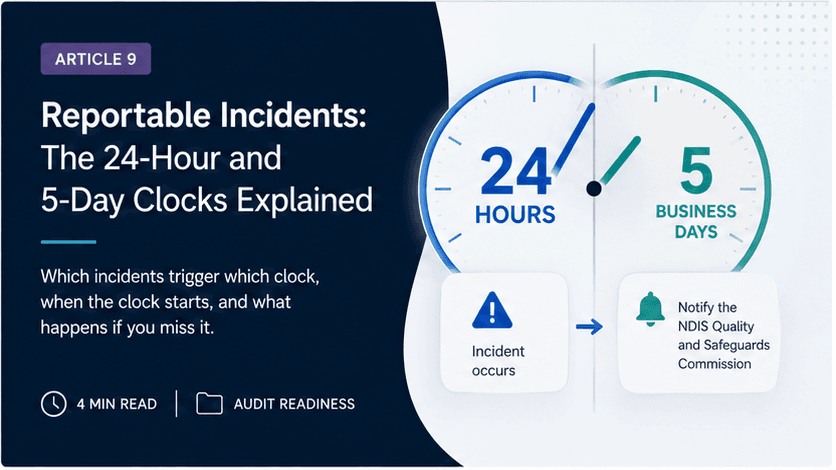
Reportable incidents run on two clocks: 24 hours and 5 business days. Mixing them up is one of the most common compliance failures.
The 24-hour clock applies to
- Death of a person with disability connected to NDIS supports
- Serious injury connected to NDIS supports
- Abuse or neglect of a person with disability
- Unlawful sexual or physical contact or assault
- Sexual misconduct (including grooming)
The 5-business-day clock applies to
- Use of a restrictive practice that is unauthorised, or not in accordance with a behaviour support plan — unless it caused harm, in which case it falls back to 24 hours.
When the clock starts
When the provider (or someone in a key personnel or managerial role) becomes aware. Not when the incident happened. Not when the participant disclosed it. When management knows.
This is why your internal escalation pathway matters. If a worker becomes aware on Friday but doesn't escalate until Monday, you've burned two days of your reporting window.
After the Immediate Notification
Within 5 business days you also submit a Five Day Form covering the full sequence of events, your response, the outcome, and what you're doing to prevent recurrence.
Records
All incident records must be kept for at least 7 years.
If you miss a deadline
Report immediately. A late report is far better than no report.