Writing a PBSP an Auditor Will Accept
A behaviour support plan that doesn't hold up to the NDIS Commission is worse than no plan at all — it creates a paper trail of work that isn't compliant.
Start with a functional behaviour assessment (FBA)
Every plan must be grounded in an FBA conducted by a registered behaviour support practitioner. The plan should reference the FBA, summarise its findings, and show how the strategies are derived from those findings.
Define behaviours precisely
"Aggression" isn't a behaviour. "Throws objects when transitioning from preferred to non-preferred activities" is. The more precise the operational definition, the more measurable the plan's outcomes.
Person-centred, not provider-centred
A reviewer should be able to identify the participant from the plan content alone. Generic plans that could apply to anyone are a flag.
Proactive strategies before reactive
Weight heavily towards proactive strategies — environmental adjustments, skill-building, communication supports, predictable routines. Reactive strategies are a last resort.
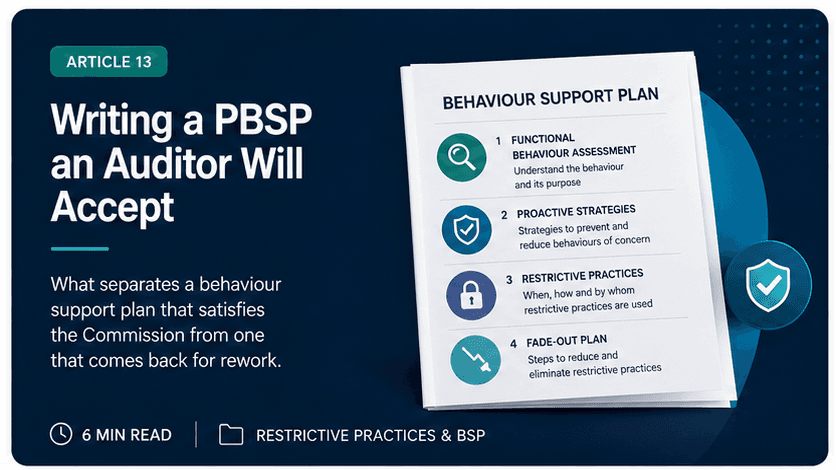
Restrictive practices need 4 things
- Identified — what is it, when can it be used, by whom
- Justified — why is it necessary, what alternatives have been tried
- Authorised — under the relevant state or territory framework
- Subject to a fade-out plan — strategy to reduce and remove it over time
A plan with no fade-out strategy will not survive audit.
Monitoring and review
Specify how outcomes will be measured, how often the plan is reviewed, what triggers an early review, and how implementing providers report back.
Training the implementers
Reference the training implementing workers need, and the implementing provider should hold records that workers have completed it.