The First-Time Provider's Guide to NDIS Registration
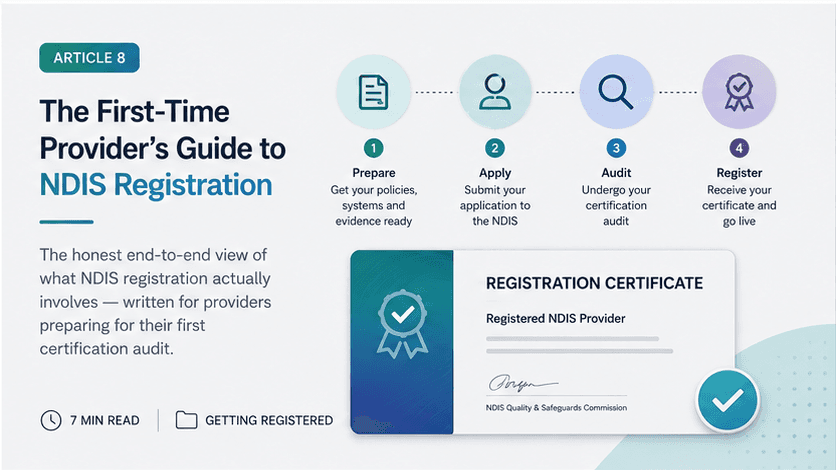
Becoming a registered NDIS provider takes longer than most people expect. Here's the end-to-end view.
Step 1: Decide if you need to register
If you only deliver supports to self-managed or plan-managed participants, you may be able to operate unregistered. If you deliver SIL, SDA, specialist behaviour support, early childhood, or supports to NDIA-managed participants, you must register.
Step 2: Pick your scope of registration
Don't over-claim. A scope of two registration groups you actually deliver is easier to defend than twelve you might deliver one day.
Step 3: Apply through the NDIS Commission Portal
The application asks for your business details, key personnel, scope, and a self-assessment against the Practice Standards. The self-assessment determines your audit pathway.
Step 4: Engage an Approved Quality Auditor
Get at least 3 quotes. Audit fees vary widely.
Step 5: Stage 1 — desktop audit
The auditor reviews your policies, procedures, registers, and management system. Verification audits stop here.
Step 6: Stage 2 — on-site audit (certification only)
1–3 days on site. The auditor interviews key personnel, observes service delivery, and speaks with participants.
Step 7: Audit report and remediation
You'll get a report listing any non-conformities. Major non-conformities must be closed before the auditor recommends you for registration.
Step 8: Commission decision
The auditor sends their recommendation to the Commission. The Commission makes the registration decision and issues your Certificate of Registration.
Budget for: auditor fees, staff time to prepare documentation, staff time to remediate findings. Plan for 3–6 months end to end.
Best preparation advice: Don't write policies that look good on paper but don't reflect how you actually work. Auditors compare documents to practice. Write what you actually do, then improve the workflow.